
Habla Español:
Call Now
Cremation Consultants Available 24/7
Call Now
Cremation Consultants Available 24/7
Cremation Rates Around The World

Cremation Rates Around The World
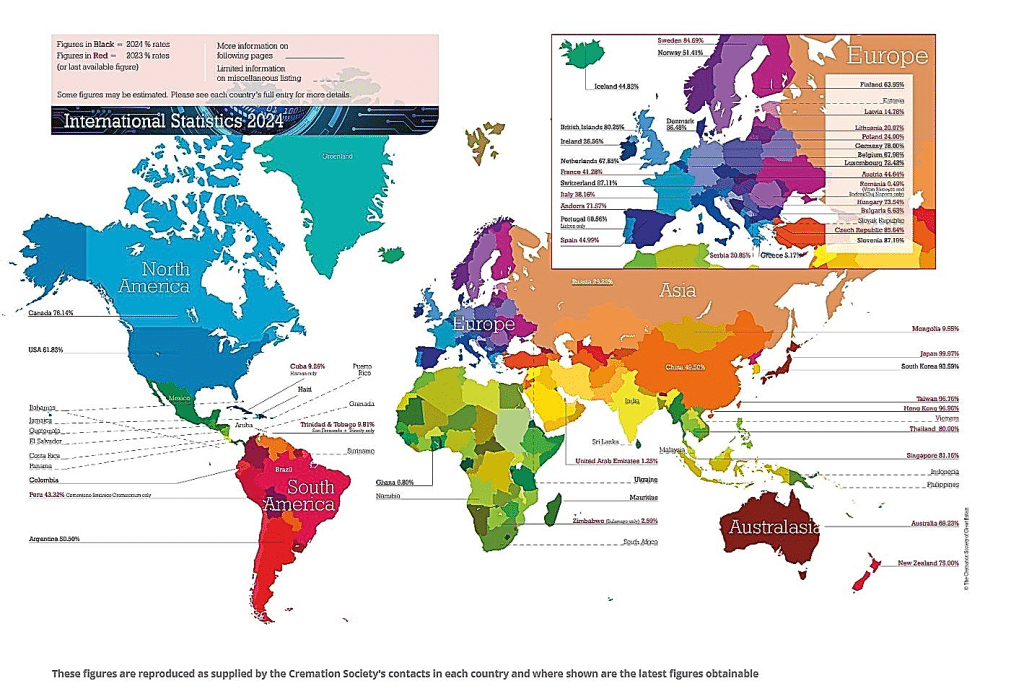
Cremation Rates Around The World. Ever wonder how many people get cremated around the world? Well, it turns out that the United States lags most industrialized countries in terms of cremation versus burial.
What Drives the Choice for Cremation?
So, why do some people opt for cremation while others stick to traditional burial? Turns out, the decision isn’t just about personal preference—it’s a swirl of cultural traditions, religious beliefs, financial pressures, and sometimes just plain practicality.
- Culture and Religion: For many, family or community customs play a starring role. In places like Japan or India, cremation has deep spiritual roots and is almost a given, while in other regions, religious traditions may lean heavily toward burial. Each group brings its own history and philosophy to the table, and often that shapes whether cremation is considered acceptable—or even encouraged.
- Financial Considerations: Let’s be honest: funerals can be expensive. Cremation is often chosen because it’s generally more budget-friendly than burials that involve caskets, plots, and other trimmings. This financial factor can tip the scales for families looking to manage costs.
- Urban Realities and Personal Values: In densely populated cities where real estate is at a premium, the lack of burial space can make cremation the more practical option. And for some, the desire for a simpler, more environmentally-friendly send-off is appealing. Others may see cremation as offering more flexibility in memorial choices—think scattering ashes in a cherished place or keeping them close at home.
In short, a weave of tradition, beliefs, wallets, and logistics all come into play—making cremation a highly personalized decision that varies widely around the globe.
According to the Cremation Society of Great Britain, in concentrated urban areas around the globe, the cremation rate is often greater than 70%. This trend is particularly evident in regions where urbanization and limited space make traditional burials less feasible. Recent international reports show that countries such as Japan, Taiwan, and Hong Kong have some of the highest cremation rates in the world, often approaching or exceeding this 70% mark.
These findings are supported by various sources, including the International Statistics report from the Cremation Society and World Population Review, which compile and compare global cremation statistics. This growing preference for cremation in densely populated areas highlights how cultural practices and practical considerations converge, especially where land is at a premium. It is thought that such a cremation rate reflects high population density and a lack of burial space.
How Religion Shapes Cremation Practices
Religion plays a decisive role in shaping cremation rates worldwide. In countries where faith traditions such as Buddhism, Jainism, or Hinduism predominate—think much of India and Southeast Asia—cremation is common and often even expected as part of end-of-life rituals. This religious support leads to significantly higher cremation rates, especially in densely populated regions.
On the flip side, societies with strong Islamic, Orthodox Jewish, or Greek Orthodox communities see far fewer cremations. In these cultures, burial is typically the preferred and sometimes strictly required practice, leading to much lower cremation rates compared to countries with more permissive religious attitudes toward the practice.
This deep connection between faith and final rites means that the prevalence of cremation in any given country is often a direct reflection of its religious makeup.
Does Age Affect Cremation Rates?
Age can also influence cremation trends within a country. For example, in South Korea, younger generations are more likely to choose cremation than older adults—those over 60 often prefer traditional burial methods. This generational difference suggests that shifting cultural values and attitudes toward end-of-life practices are contributing to rising cremation rates among the youth, especially in rapidly modernizing societies.
In certain countries, such as Japan, Taiwan, and Hong Kong, cremation is nearly universal. In fact, Japan leads the world with a cremation rate of 99.97%—almost every person who passes away is cremated. Other countries with exceptionally high rates include South Korea, Slovenia, Denmark, Czechia, and Sweden, where cremation is chosen for the vast majority of deaths, with rates ranging from 92% to nearly 85%. These figures reflect not only cultural preferences but also practical concerns like population density and scarcity of burial space, especially in urban centers.
Countries with the Lowest Cremation Rates
On the other end of the spectrum, there are places where cremation remains quite rare. Nations such as Greece, Bulgaria, Mongolia, Lithuania, and Italy are among those with the lowest cremation figures worldwide. To put it in perspective, only about 5% of deaths in Greece result in cremation, while Italy sees fewer than 40% of its deceased being cremated. These low numbers are often influenced by longstanding religious traditions, cultural preferences, and, in some cases, limited access to cremation facilities.
10050 Spanish Isles Blvd, Suite E-10
Boca Raton, FL 33498


© 2023 Sunshine Cremation Services LLC. ALL RIGHTS RESERVED. Privacy Notice.
All Funeral Services will be provided by either Sunshine Cremation Services or its parent company, Kronish, Sunshine & Co., a licensed funeral establishment. This website is for informational purposes only. No funeral services are being offered or sold herein.